
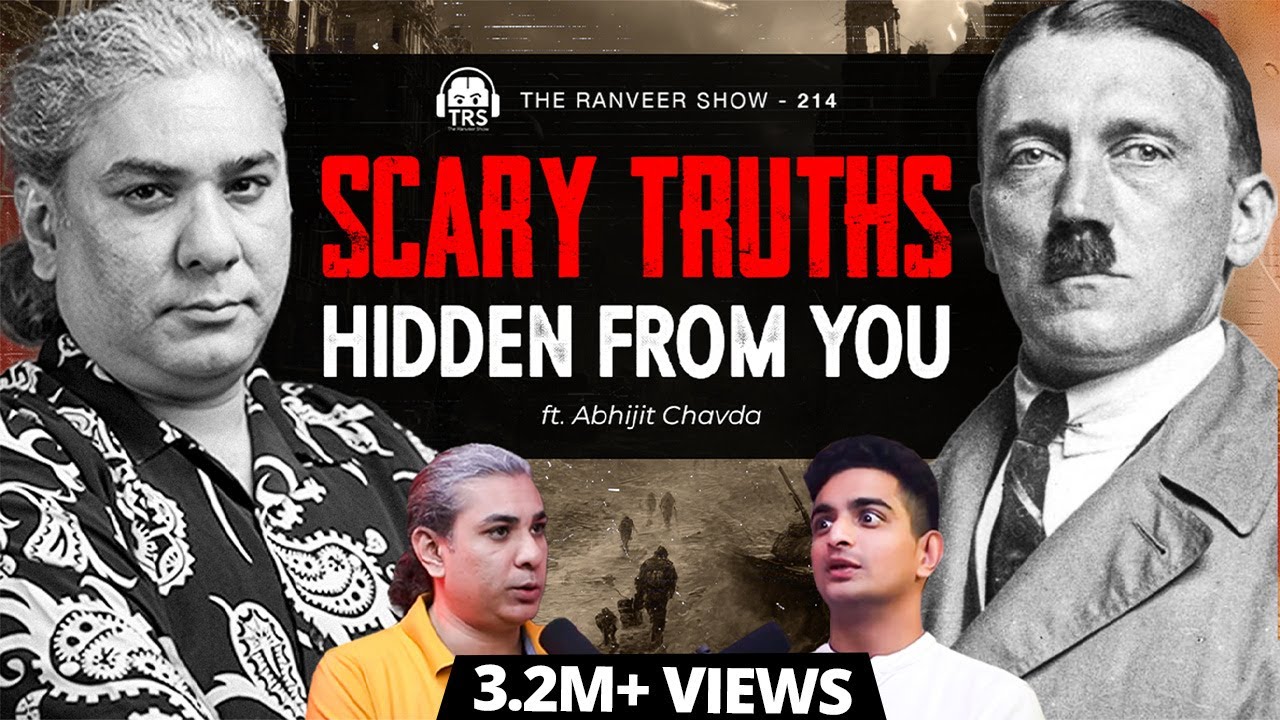
World War 2 - Abhijit Chavda On History, Conspiracies & Untold Outcomes | The Ranveer Show 214
In this summary (4)
TL;DR
- The Treaty of Versailles humiliation created the conditions for the Nazi rise to power.
- Hitler's decision to invade the USSR before defeating Britain was his fatal strategic error.
- Over 1.5 million Indian soldiers fought for the British Empire during World War II.
- The atomic bombings of Hiroshima and Nagasaki ended the war but began the Cold War.
- Post-war US occupation of Germany and Japan continues to shape global geopolitics today.
In July 1914, an assassin’s bullet in Sarajevo killed Archduke Franz Ferdinand, heir to the Austro-Hungarian throne. Within weeks, a local crisis had metastasized into a continental war. But the trigger, the historian Abhijit Chavda argues, was not the cause. The true roots lay decades earlier, in the collapse of feudal Europe and the rise of industrial empires hungry for land and prestige.
The European Tribal Wars: From Feudal Land to Industrial Empire
Chavda calls the two world wars “the European tribal wars.” Europe, he explains, had always been a place of conflict over territory and power. Under feudalism, power came from land and the agricultural produce it yielded. Then the Industrial Revolution shifted the source of wealth to factories and urban centers. The old nobility was shaken, and new rich classes emerged. Competition for markets, resources, and colonial possessions intensified. By 1914, the continent was a tinderbox of old grievances — Ottoman conversions in Bosnia, French resentment over lost territories, and German ambitions for Lebensraum. The Great War, as it was then called, introduced trench warfare from the North Sea to Switzerland, chemical weapons, and the first large-scale use of airplanes and tanks. Over a million and a half Indian soldiers fought for the British Raj; African troops were conscripted from French colonies. The war ended with the humiliating Treaty of Versailles, which blamed Germany entirely, imposed crushing reparations, and reduced its army to a mere 100,000 men. “The treaty of Versailles was nothing but a ceasefire,” Chavda notes. “A 20-year ceasefire.”
The Rise of Nazism and the Path to a Second War
The interwar years were a crucible of resentment. Hyperinflation wrecked the German economy; the Wall Street crash of 1929 sent it into a deeper spiral. Adolf Hitler, a decorated veteran of the first war, channeled national humiliation into a mythology of Aryan supremacy. He hijacked the ancient Indo-European symbol of the swastika — calling it the Hakenkreuz — and the Sanskrit term Arya to claim racial superiority. Chavda points out that Hitler broke Versailles immediately: he reintroduced conscription, built the Luftwaffe, and began producing advanced Panzer tanks. The strategy was Blitzkrieg — lightning warfare — a technique borrowed from Mongol tactics: concentrate all firepower at one point, punch through, and advance hundreds of kilometers in a week. Germany swallowed Austria, the Sudetenland, and then all of Czechoslovakia. In August 1939, Hitler signed a non-aggression pact with Stalin — the Molotov-Ribbentrop Pact — with a secret clause to divide Poland. The invasion of Poland on September 1, 1939, triggered declarations of war from Britain and France. The second European tribal war had begun.
Blitzkrieg, Barbarossa, and the Turning Tide
Germany’s early victories were staggering. France fell in weeks; the British Expeditionary Force was evacuated from Dunkirk. By 1941, all of continental Europe was under Axis control. Then Hitler made what Chavda calls “the major mistake.” In 1941, he began Operation Barbarossa — the invasion of the USSR — abandoning an invasion of Britain. The German army advanced three prongs toward Moscow, but the Red Army, despite losing three million soldiers in the first months, had an inexhaustible reserve of 14 to 15 million trained men. Stalin appealed to patriotism, not communism: “Fight for Mother Russia.” The German advance stalled at the gates of Moscow, then was ground down by the Russian winter and counterattacks. The Battle of Stalingrad and the 870-day siege of Leningrad became bywords for horror. Meanwhile, in the Pacific, Japan attacked Pearl Harbor in December 1941, drawing the United States into the war. The US launched an island-hopping campaign and, in June 1944, the D-Day landings in Normandy opened a western front. As the Soviets pushed from the east, Hitler’s Third Reich collapsed. He allegedly shot himself in his Berlin bunker in April 1945.
The Atomic End and a New Empire
The war ended with a terrible new weapon. The Manhattan Project had produced two atomic bombs, Fat Man and Little Boy. On August 6 and 9, 1945, they were dropped on Hiroshima and Nagasaki. Japan surrendered, and the US occupation began — an occupation that, Chavda argues, continues today in Japan, Germany, and South Korea. The post-war order saw the United States assume the role of the old British Empire. The United Nations was created, with the victorious powers as permanent Security Council members. India was offered a permanent seat but Prime Minister Nehru refused, insisting China be seated first. Chavda reflects that “the end of World War II was the prelude to the Cold War. The end of the Cold War was the prelude to the multipolarity we are seeing now.” He suggests that Hitler may have escaped to Argentina, as many other Nazis did — a theory he finds plausible given the lack of photographic evidence of his death. The full truth, he implies, is buried under official narratives.